Language

Imagine you are a procurement manager at an offshore drilling platform, and a sudden leak shuts down production, costing hours of downtime. After inspection, the culprit is a failed ring joint gasket. This scenario is more common than you might think. What causes ring joint gasket failure and how can it be prevented? In high-pressure, high-temperature environments, the smallest mistake in material selection, handling, or installation can lead to catastrophic gasket blowouts, corrosion, or leakage. Ring type joints (RTJs) are essential in API 6A flanges, but they demand precision. Failures often stem from incorrect hardness matching, surface damage, over-compression, or chemical attack. The good news is that with the right approach and partner — like Ningbo Kaxite Sealing Materials Co., Ltd. — these issues are entirely avoidable. In this guide, we’ll break down the causes of ring joint gasket failure in practical terms, and show you how to prevent them with proven strategies that save cost, downtime, and reputation.
The breakdown of a ring joint gasket rarely happens without warning. Common failure modes include leakage through the joint, cracking, plastic deformation, and corrosion. The underlying causes can be grouped into mechanical, environmental, and human-error factors.
Pain Point Scenario: During a routine pressure test on a newly commissioned wellhead, the RTJ gasket shows a steady pressure drop. The flange faces appear clean, but a slight indentation mismatch is discovered — the gasket hardness was too low for the flange material, causing embedment and loss of seating stress.
Solution: Always verify that the gasket hardness meets API 6A requirements relative to the flange material. Choose a supplier that provides certified material test reports and controlled hardness ranges, like Ningbo Kaxite.
| Failure Cause | Prevention |
|---|---|
| Hardness mismatch (gasket too soft) | Select gasket with correct Brinell hardness; match or slightly under flange hardness per API 6A. |
| Corrosion/erosion in sour service | Use NACE MR0175 compliant materials; soft iron or corrosion-resistant alloys. |
| Over-tightening leading to plastic collapse | Follow bolt torque specifications; use calibrated tensioning tools. |
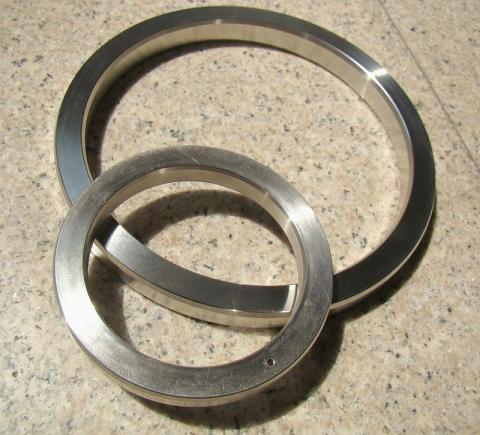
Even the finest gasket can be ruined before installation.
Scenario: An inspector finds surface scratches and rust spots on RTJ gaskets stored outdoors without protective wrapping. The operator decides to use them, thinking the seating stress will “iron out” the imperfections. Within weeks, a leak path develops along the scratched ring surface.
Solution: Keep RTJ gaskets in a dry, temperature-controlled environment with protective caps or VCI paper. Never stack them loosely. Ningbo Kaxite ships every ring joint gasket in sealed packaging with a corrosion inhibitor, and includes handling guidelines to preserve the critical sealing surfaces.
| Action | Risk if Ignored |
|---|---|
| Store in sealed bags with desiccant | Atmospheric corrosion, pitting on sealing surface |
| Use wooden or plastic dividers | Metal-to-metal contact causing nicks |
| Keep away from moisture and chemicals | Hydrogen embrittlement or stress corrosion cracking |
Material incompatibility with process fluids is a silent killer.
Scene: A refinery uses standard soft iron RTJ gaskets in a line carrying wet H2S. After six months, sulfide stress cracking leads to sudden failure during a temperature swing. The unscheduled shutdown cost exceeds $200,000.
What causes ring joint gasket failure and how can it be prevented? In this case, the answer is clear: the gasket material lacked resistance to sour environments. Prevention requires specifying NACE-compliant materials such as soft iron with controlled hardness, or upgrading to Inconel or stainless steel depending on temperature and H2S partial pressure. Ningbo Kaxite provides detailed material consultation, helping buyers choose the correct grade — from carbon steel to duplex and nickel alloys — backed by traceability and 3.1 certification.
| Service Condition | Recommended RTJ Material (Ningbo Kaxite Stock) |
|---|---|
| Sweet hydrocarbons, moderate temp | Soft Iron (DIN 1.1003), ASTM A105 compatible |
| Sour gas (NACE MR0175) | Soft Iron with hardness ≤ 120 HBW or Inconel 825 |
| High temp, high pressure, corrosive | Stainless Steel 316L, Duplex, or Inconel 625 |
The most perfectly manufactured gasket can fail if installed incorrectly. Misalignment, insufficient bolt lubrication, or uneven flange closure are top contributors.
Scenario: A technician uses a standard impact wrench without torque control to tighten the flange. The gasket compresses unevenly, causing localized yielding. Later, thermal cycling relieves some stress, and a whisper leak appears.
Solution: Adopt a controlled bolting procedure (e.g., star pattern, multiple passes, final tensioning with hydraulic tools). Also, verify flange parallelism and groove condition before placing the ring. Ningbo Kaxite supports clients with installation training materials and can provide on-site guidance to ensure proper gasket seating.
| Step | Key Parameter |
|---|---|
| 1. Align flanges and check groove | Groove surface finish Ra ≤ 3.2 µm |
| 2. Lubricate bolt threads and nut faces | Verified friction coefficient for torque calculation |
| 3. Tighten in cross-pattern steps | 3-4 passes to final target torque |
| 4. Verify with feeler gauge or dial indicator | Uniform gap around circumference |
A comprehensive prevention program combines material control, handling, installation, and inspection. Knowing “what causes ring joint gasket failure and how can it be prevented?” is the first step toward building a reliability-centered maintenance plan.
Start by selecting a gasket supplier that offers full documentation and technical support. Perform incoming inspection for hardness and surface defects. Standardize installation procedures across all sites. Implement a gasket management system that tracks service life and conditions. Finally, partner with a manufacturer like Ningbo Kaxite that views your success as their own, providing not just products but solutions.
At Ningbo Kaxite Sealing Materials Co., Ltd., we understand that procurement professionals need more than a part number. You need reliability, technical backup, and fast response. Our Ring Joint Gaskets are manufactured under strict ISO 9001 quality controls, using CNC machining for precise groove conformity. We supply a wide range of materials — from soft iron to exotic alloys — all with EN 10204 3.1 certification. Our packaging is designed to prevent transit damage and corrosion. If a failure does occur, our technical team can assist with root cause analysis and recommend immediate corrective actions. With a global customer base, we help you keep your flanges leak-free and your operations running.
Q: What causes ring joint gasket failure and how can it be prevented?
A: Typically, failures arise from hardness mismatch, corrosion, surface defects, or improper installation. Prevention involves correct material selection, careful handling, adhering to bolting procedures, and using quality-certified gaskets from trusted sources like Ningbo Kaxite.
Q: Can a ring joint gasket be reused after a hydrotest?
A: No. RTJ gaskets are designed for single use because the seating stress plastically deforms the ring, creating a seal. Reuse leads to leakage due to loss of conformability. Always replace with a new gasket after disassembly.
Blach, A.E., 2018. “Failure Analysis of Ring Type Joint Gaskets in Offshore Applications.” Journal of Pressure Vessel Technology, Vol. 140, Issue 3.
Smith, L.M. and Craig, B.D., 2019. “Corrosion Mechanisms in RTJ Gaskets in Sour Service.” Corrosion Engineering, Science and Technology, Vol. 54, No. 2.
API Specification 6A, 2020. “Specification for Wellhead and Christmas Tree Equipment.” 21st Edition, American Petroleum Institute.
NACE MR0175/ISO 15156, 2015. “Petroleum and natural gas industries — Materials for use in H2S-containing environments.”
Watanabe, T., 2017. “The Influence of Flange Surface Roughness on Gasket Sealing Performance.” International Journal of Pressure Vessels and Piping, Vol. 152.
Reddy, V.S. et al., 2020. “Bolt Preload Optimization for Ring Joint Gaskets.” ASME Pressure Vessels & Piping Conference, PVP2020-21556.
Miller, J.D., 2016. “Gasket Storage Life and Environmental Degradation.” Sealing Technology, Vol. 2016, Issue 6.
Zhu, Y. and Chen, X., 2021. “Numerical Simulation of RTJ Gasket Contact Stress at Elevated Temperatures.” Journal of Mechanical Engineering Science, Vol. 235, Issue 12.
Thompson, G.E., 2019. “Hardness Selection Guidelines for Metallic Gaskets.” Materials Performance, Vol. 58, No. 4.
Kraus, T.C. and Heine, B., 2022. “Root Cause Analysis of Premature RTJ Leaks in a Gas Processing Plant.” Engineering Failure Analysis, Vol. 135.
For over a decade, Ningbo Kaxite Sealing Materials Co., Ltd. has been a trusted partner for oil & gas, petrochemical, and power generation companies worldwide. We specialize in high-integrity ring joint gaskets, spiral wound gaskets, and other static sealing solutions, all tailored to your exact specifications. Our commitment to quality, fast lead times, and expert technical support make us the preferred choice for procurement professionals who demand reliability. Visit us at https://www.kaxite.com.cn to explore our product range, or reach our engineering team directly at [email protected] for a personalized consultation. Let us help you prevent gasket failures before they happen.