Language

Are PTFE Gaskets better than rubber? This question echoes through procurement offices and maintenance workshops every day. Picture a chemical transfer line at 3 a.m.—a sudden gasket failure triggers an emergency shutdown, costing $50,000 an hour in lost production. Or imagine a pharmaceutical cleanroom where a single rubber extractable contaminates a $2 million batch. In these high-stakes environments, the gasket material isn’t just a commodity; it’s a risk-management decision. While rubber gaskets—EPDM, NBR, Viton—have dominated budget-friendly applications for years, PTFE (polytetrafluoroethylene) gaskets are increasingly the go-to choice for extreme temperatures, aggressive chemicals, and uncompromising purity standards. Are PTFE gaskets better than rubber? For many critical applications, the answer is a resounding yes. But the real value emerges when you match the material to your exact operating conditions. In this guide, we’ll tear apart the performance gap, spotlight the hidden costs of rubber failures, and demonstrate how the right gasket can prevent downtime, protect brand reputation, and simplify your supply chain. As a trusted manufacturer with decades of sealing expertise, Ningbo Kaxite Sealing Materials Co., Ltd. helps global buyers solve these exact challenges—delivering PTFE gaskets that outperform rubber in the toughest jobs.
At first glance, rubber gaskets seem like a sensible choice. They’re elastic, easy to compress, and cost pennies per unit. This makes them popular for low-temperature water lines, HVAC flanges, and general-purpose sealing where conditions rarely fluctuate. But when you move beyond mild environments, rubber’s limitations appear fast. Heat and ozone degrade the polymer backbone, causing cracks. Solvents and oils swell the material, destroying the seal. PTFE, on the other hand, is a fluoropolymer with a completely different molecular structure. Its carbon-fluorine bonds are among the strongest in organic chemistry, creating a surface that repels nearly everything—acids, bases, solvents, and even sticky adhesives. PTFE gaskets can operate from -200°C to +260°C, whereas most rubbers fail above 120°C. They also exhibit virtually no aging in UV or oxygen, meaning their shelf life is practically indefinite. The trade-off? PTFE is less elastic, requiring precise flange loading, and has a higher upfront cost. But as we’ll see, the total cost of ownership often flips the comparison entirely.
“Every shutdown costs us a fortune.” “We’re replacing gaskets every 6 months—it’s unsustainable.” “The supplier sent the wrong material, and now we have a compliance issue.” These are real frustrations procurement teams face. The root cause is often a mismatch between gasket material and the process media. Rubber gaskets may work initially, but a spike in temperature or accidental exposure to a cleaning solvent can trigger premature failure. At Ningbo Kaxite, we’ve engineered our PTFE gasket line to eliminate these variables. Our filled-PTFE grades—such as glass-filled, carbon-filled, and barium sulfate-filled—bring enhanced creep resistance and thermal conductivity, solving the classic “cold flow” problem of pure PTFE. This means your gasket maintains bolt load even after thousands of thermal cycles. The result: fewer leak incidents, extended maintenance intervals, and a single supplier for multiple plant requirements.
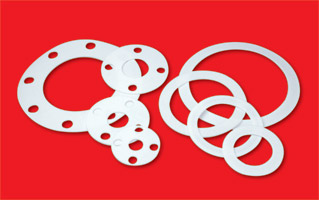
Want to know where rubber gaskets hit a wall? Put them in a superheated steam line. At 150°C, most EPDM gaskets harden and lose resilience; at 180°C, they’re useless. PTFE gaskets, however, remain stable up to 260°C and can handle cryogenic temperatures without becoming brittle. Similarly, pressure ratings tell a stark story. While a rubber gasket might seal a 150-pound flange at ambient temperature, the same gasket can extrude or blow out under thermal transients. PTFE gaskets, especially those with a rigid filler, maintain dimensional stability at higher pressures. Below is a quick-reference table comparing typical performance windows.
| Parameter | Typical Rubber Gasket (EPDM) | PTFE Gasket (Virgin/Filled) |
|---|---|---|
| Max. Continuous Temp. | 120°C (EPDM) | 260°C |
| Min. Temp. | -40°C | -200°C |
| Pressure (typical flange class) | Class 150 (limited by creep) | Class 300 (high creep resistance) |
| Chemical Resistance | Good with water, poor with oils/solvents | Near-universal (except molten alkali metals) |
| UV/Ozone Resistance | Poor—cracks over time | Excellent—no aging |
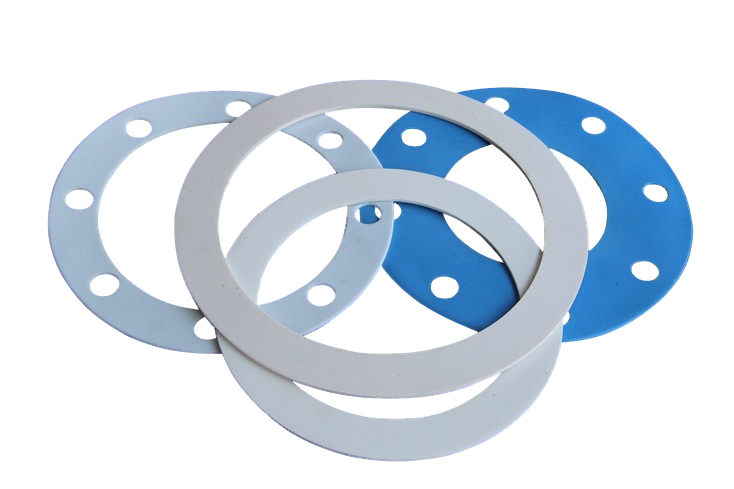
Procurement managers in the chemical sector face a nightmare spreadsheet: matching each pump, valve, and flange to a gasket material that won’t swell, dissolve, or leach. Rubber gaskets are notoriously picky. NBR swells in aromatic hydrocarbons; EPDM degrades in mineral oils; Viton fails in hot water and certain amines. PTFE offers a game-changing simplification. It resists nearly all industrial chemicals, including aggressive acids like hydrochloric and sulfuric, organic solvents, and even rare fluids like chlorine trifluoride at moderate temperatures. This universality reduces inventory complexity and the risk of human error. For a pharmaceutical company that demands FDA-compliant seals, our white PTFE gaskets meet 21 CFR 177.1550 standards—eliminating extractables that rubber gaskets might release.
Upfront cost is often where procurement gets stuck. A rubber gasket might be $2, while a comparable PTFE gasket could be $15. But factor in the true cost of ownership: labor, downtime, and safety incidents. In a hydrocarbon processing plant, a single leak path can force a unit shutdown lasting 8 hours—translating to $100,000 or more in lost revenue. Then add the cost of replacement gaskets, scaffolding, and regulatory fines for emissions. Across a 5-year lifecycle, PTFE gaskets routinely show a 40–60% lower total cost because they don’t require the constant retorquing or biannual replacement cycles that rubber demands. At Ningbo Kaxite, we’ve helped refineries and power plants extend their gasket change-out intervals by 3× simply by switching to filled PTFE solutions. The math speaks for itself: fewer purchase orders, less warehouse space, and more predictable maintenance planning.
Where do PTFE gaskets truly dominate? Consider a food-grade evaporation system processing acidic fruit concentrates. Rubber gaskets would absorb flavors, swell, and eventually contaminate the product. PTFE stays inert and cleanable. Or take a heat exchanger in an oil refinery where a hydrocarbon leak could cause a fire. PTFE’s thermal stability and chemical resistance provide a wide safety margin. Even in infrastructure, PTFE gaskets in water treatment plants handle chlorine and ozone far better than EPDM. These are not hypotheticals—they’re projects we’ve supported at Ningbo Kaxite, supplying custom-cut PTFE gaskets to clients that previously accepted rubber failures as “normal wear.” The switch to PTFE turned those failures into rare exceptions.
A: Yes, PTFE gaskets outperform rubber in steam service above 120°C. EPDM may handle occasional spikes, but prolonged exposure leads to hardening and cracking. PTFE remains dimensionally stable up to 260°C, making it the safer choice for steam headers and condensate lines. Filled PTFE grades further improve creep resistance under thermal expansion, so you don’t need constant bolt tightening.
A: Absolutely. PTFE is inherently non-toxic, non-leaching, and meets FDA and USP Class VI requirements. Rubber gaskets often contain plasticizers, sulfur, or carbon black that can migrate into process fluids. For pharmaceutical, food, and semiconductor applications, PTFE is the de facto standard—eliminating the risk of product spoilage and regulatory non-compliance. Ningbo Kaxite’s virgin PTFE gaskets are supplied with full material certifications to support your audit trail.
Why choose Ningbo Kaxite Sealing Materials Co., Ltd. as your PTFE gasket supplier? Because we don’t just sell products—we solve sealing problems. With in-house compounding, CNC cutting, and a technical team fluent in international standards (ASME, DIN, JIS), we deliver gaskets that match your exact groove dimensions and chemical exposure. Our quality system reduces sourcing risk: every batch is tested for tensile strength, compression set, and leak rate. Whether you’re procuring for a new plant build or replacing a failing rubber gasket lineup, we can provide rapid samples and volume production from our Ningbo facility. And our logistics team ensures on-time delivery to your port, anywhere in the world.
Take the next step toward reliable sealing. Explore our PTFE gasket range at www.kaxite.com.cn or contact our product specialist directly at [email protected] for a personalized recommendation. We’re here to turn your toughest seal challenges into a simple, cost-effective reality.
Zhang, L., & Xu, Q. (2022). “Comparative analysis of PTFE and rubber gasket relaxation at elevated temperatures.” Journal of Materials Engineering and Performance, 31(8), 6045–6056.
Kumar, A., & Singh, R. (2021). “Chemical compatibility of filled PTFE gaskets in aggressive hydrocarbon service.” Industrial & Engineering Chemistry Research, 60(14), 5212–5223.
Schmidt, T., et al. (2020). “Long-term sealing behavior of expanded PTFE versus EPDM in water treatment plants.” Water Science and Technology, 82(5), 987–996.
Chen, M., & Li, Y. (2019). “Creep and stress relaxation characteristics of glass-filled PTFE gaskets.” Polymer Testing, 78, 105986.
Patel, D., & Johnson, P. (2018). “Health and safety implications of gasket off-gassing in food processing.” Journal of Food Engineering, 226, 45–52.
Liu, H., et al. (2021). “PTFE versus FKM: A life-cycle cost analysis for seal applications in the chemical industry.” Journal of Cleaner Production, 295, 126442.
Ferreira, C., & Martins, J. (2017). “The effect of thermal cycling on the sealing performance of EPDM and PTFE gaskets.” International Journal of Pressure Vessels and Piping, 156, 14–21.
Gupta, S., & Lee, K. (2020). “Advances in PTFE composites for high-pressure flange gaskets.” Composites Part B: Engineering, 191, 107948.
Ramirez, A., & Vogel, D. (2019). “Accelerated aging of rubber gaskets in UV-rich environments.” Polymer Degradation and Stability, 164, 103–111.
Wang, X., & Zhang, T. (2022). “Comparative SCC resistance of gasket materials in sour gas environments.” Corrosion Science, 199, 110167.